
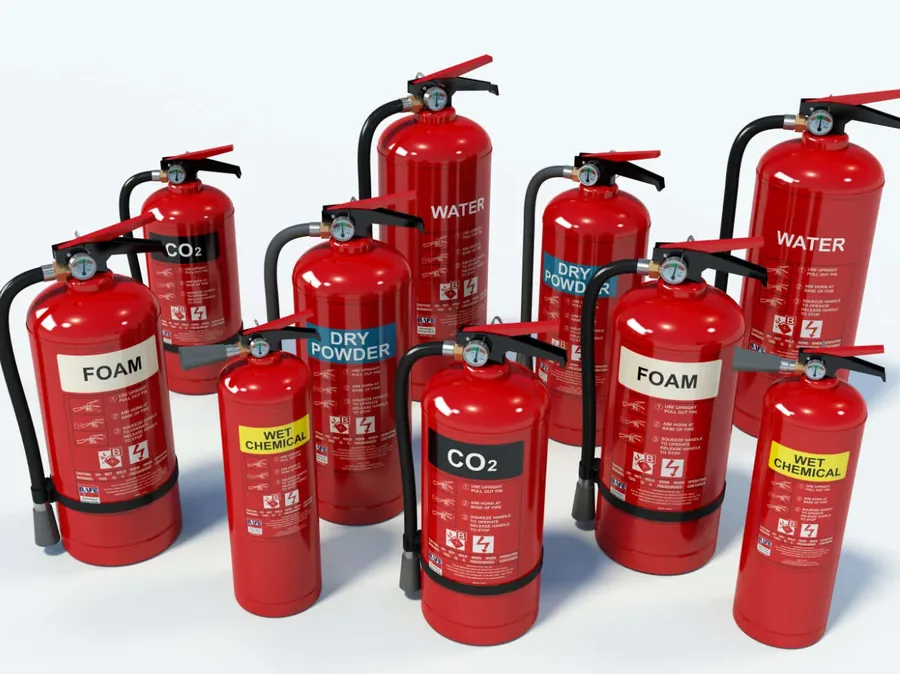
Walk into any office, factory, hospital or hotel in Bhopal and you'll see a red cylinder mounted on the wall. But did you know that using the wrong fire extinguisher on the wrong type of fire can make things worse; not better?
India has six main types of fire extinguishers: each designed for a specific class of fire. The wrong extinguisher on an electrical fire can electrocute you. The wrong one on a cooking oil fire can cause a violent explosion. Getting the specification right is not just a compliance requirement; it is a life-safety decision.
This guide explains every type of fire extinguisher available in India, which fire class each one covers, and which buildings in Bhopal and Madhya Pradesh legally require them under IS 2190 and the NBC.
First: understand the 6 classes of fire in India
Before choosing an extinguisher you need to know what class of fire you're protecting against. Indian standard IS 2190 classifies fires into six categories:
| Class | Type of fire | Examples |
| Class A | Solid materials | Paper, wood, cloth, plastic, rubber: typical office or warehouse fire |
| Class B | Flammable liquids | Petrol, diesel, paint, solvents, chemical storage areas |
| Class C | Flammable gases | LPG, CNG, natural gas, acetylene |
| Class D | Combustible metals | Magnesium, sodium, potassium: industrial and laboratory environments |
| Class E | Electrical fires | Electrical panels, switchboards, server rooms, computers, wiring |
| Class F | Cooking oils and fats | Deep fryers, commercial kitchens, restaurant cooking areas |
1. ABC Dry Powder Extinguisher: the most common type in India
The ABC dry powder extinguisher is the most widely used fire extinguisher in India and the standard requirement for most buildings in Bhopal and Madhya Pradesh under IS 2190. It discharges a fine chemical powder that smothers the fire and interrupts the chemical reaction.
Fire classes covered: A, B and C
Available capacities: 1kg, 2kg, 4kg, 6kg, 9kg, 25kg, 50kg, 75kg
Best for:
- Offices, schools, shops and commercial buildings
- Factories and warehouses storing general materials
- Vehicles: mandatory for commercial vehicles in India
- Construction sites and general industrial environments
Do NOT use for:
- Server rooms and electrical equipment: powder damages electronics permanently
- Cooking oil fires: can cause a violent flashback
- Clean environments where residue is unacceptable
- Price range in Bhopal: 1kg from Rs 900-1000. 4kg from Rs 1350-1450. 9kg from Rs 1,500 to 2,200.
2. CO2 (Carbon Dioxide) Extinguisher: essential for electrical areas
CO2 extinguishers discharge carbon dioxide gas which suffocates the fire by displacing oxygen. They leave absolutely no residue: making them the only safe choice for electrical panels, server rooms, data centres and laboratory equipment where powder would cause catastrophic damage.
Fire classes covered: B and E (electrical fires)
Available capacities: 2kg, 4.5kg, 6.5kg, 9kg
Best for:
- Electrical panels, DBs and switchrooms: mandatory requirement
- Server rooms and data centres
- Laboratories and medical equipment areas
- Banks, offices with significant IT infrastructure
- Telecom and broadcasting equipment rooms
Important: CO2 is not suitable for Class A fires: it does not soak into burning materials. Every building should have both CO2 (for electrical areas) and ABC powder (for general areas) to be fully compliant under IS 2190.
Price range in Bhopal: 4.5kg from Rs 4700-4900. 9kg from Rs 8800-9200
3. Foam (AFFF) Extinguisher: for liquid and fuel fires
AFFF (Aqueous Film Forming Foam) extinguishers are designed for flammable liquid fires. The foam forms a blanket over the burning liquid, cutting off the oxygen supply and preventing re-ignition. They are significantly more effective on liquid fires than dry powder.
Fire classes covered: A and B
Available capacities: 9 litres, 25 litres, 50 litres
Best for:
- Fuel storage areas and petrol stations
- Chemical warehouses and paint storage
- Vehicle workshops and garages
- Printing presses and solvent storage
- Price range in Bhopal: 9 litres from Rs 2,300 to 2,500.
4. Water Extinguisher: for Class A fires only
Water extinguishers cool the burning material below its ignition temperature. They are effective only on Class A fires, burning solids like paper, wood and textiles. They must never be used on electrical fires (electrocution risk) or liquid fires (spreading risk).
Fire classes covered: A only
Best for:
- Schools and libraries: large volumes of paper
- Textile warehouses
- Hotels storing large quantities of soft furnishings
- Wood storage and sawmills
- Do NOT use for: Electrical fires, liquid fires, kitchen fires.
5. Clean Agent Extinguisher (FM200, Novec, CO2 system): for high-value equipment
Clean agent extinguishers discharge a gas or vaporising liquid that suppresses fire without leaving any residue. They are safe for sensitive electronics, valuable documents and occupied spaces. FM200 and Novec 1230 are the most common clean agents in India.
Fire classes covered: A, B and E
Best for:
- Server rooms and data centres: gold standard protection
- Telecom equipment rooms
- Museums and archive rooms
- Medical equipment and MRI rooms
- Bank vaults and document storage
Note: Clean agent extinguishers are significantly more expensive than CO2 or ABC units. They are typically installed as fixed suppression systems rather than portable extinguishers for large-scale protection.
6. Trolley-Mounted Extinguisher: for factories and large industrial sites
Trolley-mounted extinguishers are large-capacity units, typically 25kg to 250kg, mounted on wheeled trolleys for mobility across large industrial sites. They are available in ABC dry powder, CO2 and foam variants and are commonly seen in factories, chemical plants, power stations and construction sites.
Available capacities: 25kg, 50kg, 75kg, 100kg, 150kg, 250kg
Best for:
- Factories and manufacturing units
- Chemical and petrochemical plants
- Power stations and electrical substations
- Construction sites
- Aircraft hangars and fuel storage depots
Quick reference: which extinguisher for which building?
Use this table to identify the right extinguisher for your building type:
| Building type | Recommended extinguisher | Minimum requirement |
| Office | ABC dry powder + CO2 for electrical areas | 1 per 200 sq m + CO2 near panels |
| School or college | ABC dry powder + water for library areas | 1 per classroom + 1 per 100 sq m |
| Hospital | CO2 for ICU/equipment areas + ABC for corridors | As per NBC: varies by floor area |
| Hotel | ABC + CO2 + kitchen suppression system | As per MP Fire Department NOC requirements |
| Factory / warehouse | ABC + trolley-mounted for large areas | As per IS 2190: based on fire load |
| Server room | CO2 or clean agent (FM200) | Fixed suppression system recommended |
| Commercial kitchen | Class F wet chemical + ABC | Mandatory under NBC for commercial kitchens |
| Fuel / chemical storage | Foam (AFFF) + ABC | As per IS 2190: hazardous area classification |
| Electrical substation | CO2 or dry powder (ABC) | As per CEA regulations |
How many fire extinguishers does your building need?
Indian standard IS 2190 specifies the minimum number of extinguishers required based on floor area and fire risk. The general rule for most commercial buildings is:
- One 4kg ABC extinguisher for every 200 square metres of floor area
- Minimum one extinguisher per floor regardless of floor area
- One CO2 extinguisher near every electrical panel, DB room or server room
- Additional trolley-mounted units for high-risk industrial areas
- Extinguishers must be mounted at a height of 1 to 1.5 metres from the floor and clearly signed
For the exact requirement for your specific building, contact a certified fire safety consultant. The MP Fire Department requires a site-specific fire safety plan as part of the Fire NOC application process.
How often should fire extinguishers be serviced?
Under IS 2190, all fire extinguishers must be inspected and serviced annually by a certified agency. The service includes a pressure check, internal inspection, agent weight or pressure verification, safety seal replacement and service label update. A service certificate must be issued after every inspection; this is required for Fire NOC renewal in Madhya Pradesh.
In addition to annual servicing, extinguishers should be visually inspected monthly, check the pressure gauge, safety pin, nozzle and condition of the cylinder. Any extinguisher that has been discharged, even partially, must be recharged immediately.
Need help choosing the right fire extinguisher in Bhopal?
Fire Protection System has been supplying, installing and servicing fire extinguishers across Bhopal and Madhya Pradesh since 1995. We are authorised dealers for Kanex and Savemax and supply all types of ISI and BIS certified extinguishers, ABC, CO2, foam, water and clean agent, at the best prices in Bhopal.
We also provide free advice on the right specification for your building, just call or WhatsApp us and our team will tell you exactly what you need, how many, and where to position them for IS 2190 compliance and Fire NOC approval.
Call or WhatsApp: +91 92440 89060 | Email: sales@fireprotectionsystem.co | fireprotectionsystem.co/fire-extinguisher-bhopal