
In September 2026, civic authorities sealed 11 paying guest accommodations and hostels in the Lohegaon area of Pune for fire safety violations and missing permissions. The same rules apply in Madhya Pradesh: a PG, hostel, coaching centre or lodge that operates without a valid Fire NOC and working fire protection equipment can be sealed. If you run such a building in Bhopal, verify your occupancy approval, Fire NOC status, escape routes, alarm system and extinguisher servicing this week.
What happened in Pune, and why it matters here
According to reports in India Today, Hindustan Times, The Times of India and Pune Times Mirror, civic authorities sealed 11 paying guest accommodations and hostels in the Lohegaon area of Pune in September 2026. The reason given in the reports was fire safety violations and missing permissions, buildings running as shared residential accommodation without the fire safety systems and approvals the law expects.
Bhopal, Indore, Jabalpur and Gwalior all have the same building type in large numbers: houses and small apartment blocks converted into PGs and hostels for students and working people, often near coaching hubs, colleges and hospitals. The conversion usually happens quietly. The building was approved as a residence; it is now used as a small hostel with far more occupants, more electrical load, more cooking points and the same single staircase. That gap between approved use and actual use is exactly what enforcement drives target.
The rules that apply to PGs, hostels and lodges in Madhya Pradesh
Fire safety in India is governed mainly by the National Building Code (NBC) 2016, which state fire services and municipal bodies adopt through local rules. NBC classifies buildings by occupancy. A residential building where rooms are let out to multiple unrelated occupants, a hostel, PG, lodging house or dormitory, is treated as a residential occupancy with its own requirements for exits, staircases, alarm and firefighting provision. The requirements get stricter as the building gets taller or more crowded.
In Madhya Pradesh, the Fire NOC is issued through the fire service wing of the local municipal body, with the MP Fire Department framework behind it. There are usually two stages: a provisional approval based on drawings before or during construction, and a final NOC after inspection of the installed systems. Renewal is periodic. A building that changed its use after getting occupancy approval generally needs the change of use regularised before a Fire NOC can be issued against the new occupancy.
If you are unsure which stage your building is at, our Fire NOC consultant team in Bhopal can review your drawings and existing paperwork before you approach the department. You can also read our step-by-step guide to getting a Fire NOC in Madhya Pradesh.
A same-week checklist for PG, hostel and lodge owners
None of this needs a consultant to start. Walk your building with a notebook and check the following.
- Approved use versus actual use. Pull out your building permission and occupancy certificate. Does the approved use match what the building is doing today? If not, this is your first problem to solve.
- Fire NOC status. Find the certificate, check the validity date and check whose name and address it carries. An expired NOC and no NOC look the same to an inspector.
- Exit routes. Walk from the furthest room to the street. Is the staircase clear of stored luggage, scooters, cylinders and shoe racks? Is the final exit door unlocked and openable from inside at 2 am?
- Second escape route. Many converted houses have one staircase. Identify whether an alternative escape route, external staircase or protected route is feasible, and get it assessed.
- Alarm. Is there a fire alarm with detectors in corridors and a sounder loud enough to wake a sleeping occupant on the top floor? Press the test call point and listen.
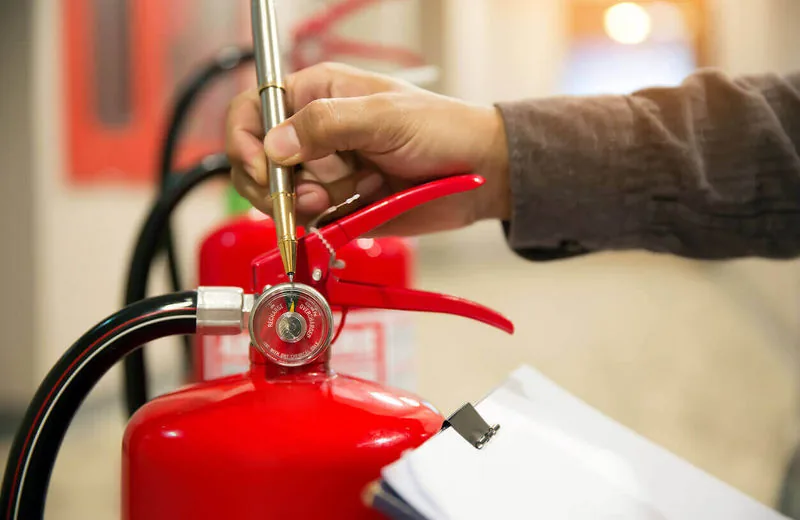
- Extinguishers. Check the pressure gauge, the last refilling date and whether staff or the caretaker know how to use one.
- Electrical load. Count the geysers, induction plates, heaters and extension boards. Converted buildings usually run far beyond the load the original wiring was sized for.
- Cooking and cylinders. LPG cylinders stored in corridors or under staircases are a common and serious violation.
- Emergency lighting and signage. In a night-time power cut with smoke, occupants need lit exit signs, not phone torches.
- Contact list. Fire brigade number, owner, caretaker and nearest hospital displayed at the entrance and on every floor.
If your building fails more than three items on this list, treat it as urgent rather than as a to-do for next quarter.
What inspectors typically look for, and the usual gap
| Area | What is expected | Common situation in converted buildings |
|---|---|---|
| Occupancy approval | Building used for the purpose approved | Residence running as a PG or hostel |
| Fire NOC | Valid, renewed, matching the current occupancy | Expired, or issued for the old use |
| Means of escape | Clear, lit, adequate width, alternative route where required | Single staircase used for storage |
| Detection and alarm | Detectors and sounders covering sleeping areas | No system, or panel switched off to stop nuisance alarms |
| Extinguishers | Right type, right place, in date, staff trained | Present but years past refilling date |
| Wet systems | Hydrant or sprinkler provision as per building height and area | Pump not run for months, tank level unknown |
| Records | Service certificates, test logs, drill records | No paperwork at all |
That last row causes more trouble than owners expect. At renewal time the department wants evidence that systems are maintained, not just installed. A fire safety AMC with service certificates produces that evidence every visit. AMC cover for small offices and small buildings starts from Rs 3,500 a year.
Where the rules may be heading: risk-based classification
There is also a compliance-side story worth watching. The Hindu and NewsMeter reported in late September 2026 that Telangana Fire Services has proposed a risk-based classification for industrial Fire NOCs, grouping units into G1, G2 and G3 risk categories to simplify the process.
This is a proposal in another state, not a rule in Madhya Pradesh. But the direction is familiar: lighter paperwork for genuinely low-risk premises, sharper scrutiny for high-risk ones. For an owner in MP the practical lesson is that simplification usually comes with better record-keeping and self-declaration, and a self-declaration you cannot support with test records is a liability. Build the file now.
Hostels and PGs are a night-time risk, which changes the design
A factory fire at 3 pm has alert adults who know the building. A hostel fire at 3 am has sleeping occupants, many of them new to the city and to the building. That single difference drives three design priorities.
- Detection first. People must be woken before smoke reaches the corridor. A properly zoned fire alarm system matters more in a hostel than in almost any other small building.
- Protected escape. Smoke fills a staircase quickly. Keeping the stair clear and enclosed is often the cheapest life-safety improvement available.
- A person in charge. A caretaker who knows how to raise the alarm, call the fire brigade, cut the main electrical supply and account for occupants is part of the safety system.
If you want an outside view, a fire safety audit puts the gaps in writing with a priority order, and our audit report is issued in three working days. That report is also useful when you need to explain to a landlord or a partner why a particular item cannot wait.
Who should act on this now
- PG and hostel owners near coaching hubs, colleges and hospitals in Bhopal
- Institutions running their own hostel blocks
- Owners of residential buildings let out floor-wise to multiple tenants
- Lodges, guest houses and service apartments
- Anyone whose Fire NOC was issued against a use the building no longer has
Fire Protection System has worked on fire safety in Bhopal and across Madhya Pradesh since 1995. If you want your building reviewed before someone else reviews it, call or WhatsApp +91 92440 89060 or write to sales@fireprotectionsystem.co.
Frequently asked questions
Does a PG or hostel in Bhopal need a Fire NOC?
My building has a Fire NOC from when it was a residence. Is that enough now that it is a PG?
What is the single most important thing to fix first in a hostel?
How often do fire extinguishers need refilling?
Can a building really be sealed for fire safety violations?
What records should I keep ready for a fire inspection?
Sources
- 11 Pune PGs, hostels sealed over fire safety violations, missing permissions, India Today
- 11 PG hostels in Pune sealed for lacking fire safety systems, Hindustan Times
- 11 PGs, hostels sealed in Lohegaon over fire safety violations, The Times of India
- 11 PGs, Hostels Sealed in Lohegaon Over Fire Safety Violations, Pune Times Mirror
- Telangana Fire Services proposes risk-based classification to simplify industrial Fire NOCs, The Hindu
- Telangana to simplify industrial fire NOCs with G1, G2 and G3 risk categories, NewsMeter