
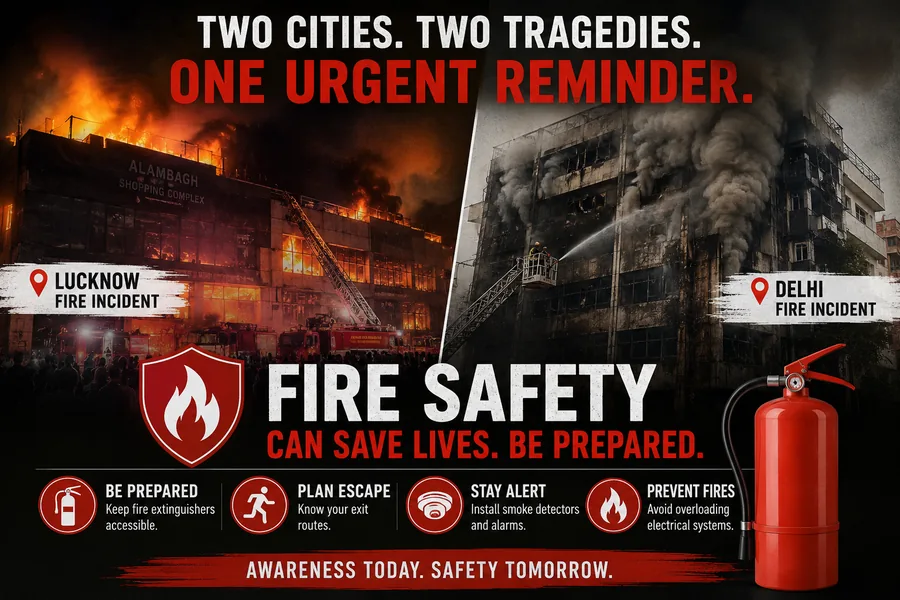
In the span of a few weeks, India has witnessed two devastating fires that took the lives of more than 35 people combined: a guesthouse fire in Malviya Nagar, Delhi, and a coaching centre fire in Aliganj, Lucknow. Our thoughts are with the families who lost loved ones in both tragedies. These were not isolated accidents. They were preventable disasters, and the patterns behind them are now under close examination by fire departments across India, including here in Bhopal.
Madhya Pradesh fire authorities have already begun inspecting coaching centres and commercial buildings across Bhopal in direct response to these incidents. If you own or manage a coaching centre, hotel, hospital, factory, or commercial building, an inspection may already be on its way, and the time to get your documentation and safety systems in order is now, not after an inspector arrives.
What Happened: A Brief, Factual Summary
In early June 2026, a fire broke out at the Flourish Stay Bed and Breakfast in Malviya Nagar, Delhi, killing 21 people. Investigators found that a power outage caused by a basement fire jammed the building's electronic key-card doors and sensor-operated main gate, trapping more than 50 guests inside. The property owner later admitted he never had a fire safety NOC for the building.
On June 22, 2026, a fire broke out at a coaching centre in Aliganj, Lucknow, killing at least 14 students. The building had been illegally converted from residential to commercial use years earlier. A demolition order issued in 2016 was reversed just two months later, allowing the structure to operate unchecked for over a decade. The fire's electrical disruption jammed a biometric entry system, permanently locking students inside, while the roof access door was found padlocked.
Both fires share a disturbing pattern: unauthorised building use, blocked or failed emergency exits, and an electrical fault that disabled the very systems meant to let people escape.
The Pattern Behind Both Tragedies: And Why It Matters for Your Building
Looking past the specific details, three failures repeat in both cases. Understanding them is the first step to making sure your own building does not face the same risk.
1. Electrical faults disabling escape routes
In both fires, an electrical failure did not just start or spread the fire, it disabled the systems people needed to escape. Electronic locks, biometric entry systems, and powered gates that fail-lock during a power cut turn an emergency exit into a trap. This is precisely why a proper electrical safety audit, alongside your fire safety audit, matters: it identifies wiring faults and power vulnerabilities before they become a life-safety issue, not after.
2. Single or blocked exit points
In the Lucknow fire, the roof access was padlocked and there was effectively one usable escape route once the ground floor was engulfed. A compliant building under NBC 2016 requires multiple, clearly marked, unobstructed exits sized for the building's occupancy. This is checked during every proper fire safety audit; and it is one of the most common violations found in older or informally expanded commercial buildings.
3. Unauthorised or undocumented building use
Both buildings had a documented history of illegal commercial conversion or unclear regulatory status. A valid Fire NOC is not just paperwork; it confirms that a qualified authority has actually verified your building's fire safety systems against its real, current use. If your building has been extended, repurposed, or never formally inspected, this is the gap that puts you at the same risk these two buildings faced.
If You Run a Coaching Centre, Tuition Centre, or Institute
Coaching centres are now under direct scrutiny following the Lucknow fire. Fire departments across Madhya Pradesh, including Bhopal, have already begun inspection drives specifically targeting coaching institutes. If you run one, here is what an inspector will be checking:
- Number and width of emergency exits relative to student occupancy
- Whether exits are locked, padlocked, or obstructed during operating hours
- Functioning fire alarm and smoke detection system
- Fire extinguishers: correct type, correctly serviced and tagged
- Electrical wiring condition, especially in older or converted buildings
- Valid Fire NOC matching the building's actual current use
- Clear, unlocked access to roof or alternate escape routes
- If you are not confident your centre would pass this checklist today, the time to find out is before the inspector arrives, not during the inspection.
If You Run a Hotel, Guesthouse, or B&B
The Delhi guesthouse fire has put particular focus on smaller hotels and B&Bs, properties that often grow informally over the years without revisiting their original fire safety design. Two areas deserve special attention beyond the basics:
Kitchen Fire Suppression Systems
Hotel kitchens are a leading source of fire risk due to high-heat cooking oils and constant flame or electrical heat sources. A proper kitchen requires a dedicated wet chemical fire suppression system covering the cooking range, hood, and exhaust duct; not just a fire extinguisher kept nearby. These systems detect heat directly above the cooking surface and automatically discharge a suppressant that smothers oil and grease fires, which behave very differently from ordinary fires and cannot be safely handled with water.
Alongside the suppression system, every commercial kitchen should have a Class B or Class K fire extinguisher specifically rated for cooking oil and grease fires, positioned for immediate access without crossing through the cooking area itself.
Automatic Suppression for Guest Floors
Beyond the kitchen, guest floors and corridors benefit from automatic sprinkler coverage, particularly important in buildings with more than a few rooms or multiple floors, where guests may be asleep and unable to respond quickly to an alarm. Combined with interlinked smoke detectors that trigger a building-wide alarm rather than just a local one, this gives guests the maximum possible time to evacuate.
Critically, and this is the exact failure in the Delhi fire, any electronic door lock, key-card system, or automated gate must have a verified fail-safe mechanism that defaults to unlocked during a power failure or fire alarm trigger. This should be tested, not assumed.
If You Run a Factory, Hospital, or Commercial Building
The same underlying risks apply at larger scale, with additional compliance requirements:
- Factories with 250kW+ electrical load require a statutory electrical safety audit under the Electricity Rules 2003, separate from your fire safety audit
- Hospitals require progressive evacuation planning given patients who cannot self-evacuate quickly
- Any building that has changed use, added floors, or expanded beyond its original sanctioned plan needs its Fire NOC reviewed against current occupancy, not the original building plan
- Emergency lighting and exit signage must remain functional during a power outage, battery backup should be tested, not assumed
What FPS Can Do for You: Right Now
We understand that after seeing these tragedies, many building owners want clarity and want it quickly. Fire Protection System has been conducting fire safety audits, Fire NOC documentation, and compliance work across Bhopal and Madhya Pradesh since 1995. Here is how we can help you get ahead of an inspection rather than be caught by one:
- Fire Safety Audit: a complete inspection of your exits, alarm systems, extinguishers, and fire suppression infrastructure against NBC 2016 and MP Fire Act requirements, with a certified report you can present to inspecting authorities
- Electrical Safety Audit: conducted by a retired MP Power Generating Company Executive Engineer, identifying exactly the kind of electrical faults that disabled escape systems in both recent fires, including infrared thermography to catch hidden wiring problems
- Fire NOC Documentation and Renewal: we handle the complete application or renewal process with the MP Fire Department, ensuring your documentation matches your building's actual current use
- Kitchen and Commercial Suppression Systems: design, supply, and installation of wet chemical kitchen suppression systems and sprinkler systems for hotels, restaurants, and commercial kitchens
- Annual Maintenance Contracts: so that once your systems are compliant, they stay that way, with scheduled testing and a maintenance record ready for any future inspection
Both the Lucknow and Delhi tragedies happened in buildings where basic fire safety compliance was either missing or had quietly lapsed over time. The single most important thing you can do this week is find out, with certainty, where your own building stands.
Frequently Asked Questions
My building already has a Fire NOC. Do I still need to worry?
An existing Fire NOC confirms your building was compliant at the time it was issued. If your building's use, occupancy, or layout has changed since, including any unofficial extensions or repurposed floors, the NOC may no longer reflect reality, which is exactly the gap that contributed to both recent tragedies. A fresh audit confirms whether your current documentation still matches your current building.
How quickly can FPS conduct an audit given the current inspection drives?
We understand the urgency many building owners are feeling right now. Contact us directly and we will prioritise scheduling based on your situation, particularly if you have already been notified of an upcoming inspection.
What is the difference between a fire safety audit and a Fire NOC?
A fire safety audit is an independent inspection that identifies gaps and risks in your fire safety systems. A Fire NOC is the official certificate issued by the fire department confirming your building meets the required standards. Most building owners need an audit first to identify and fix any gaps before a Fire NOC application or renewal will succeed.
Do small coaching centres and guesthouses really need all of this?
Both recent tragedies occurred in exactly this category of building, a small coaching centre and a six-room guesthouse, not large institutional buildings. Fire risk does not scale only with building size; it scales with occupancy, exit availability, and electrical condition, all of which can be just as critical in a small building as a large one.
Get Your Building Checked This Week
If recent events have made you want certainty about your building's fire and electrical safety, we are ready to help. Contact us for a fire safety audit, electrical safety audit, or Fire NOC documentation review.
Call / WhatsApp: +91 9244089060
Email: sales@fireprotectionsystem.co
Serving Bhopal, Mandideep, Sehore, Vidisha, Hoshangabad, Raisen, Itarsi, Narsinghpur and all of Madhya Pradesh.