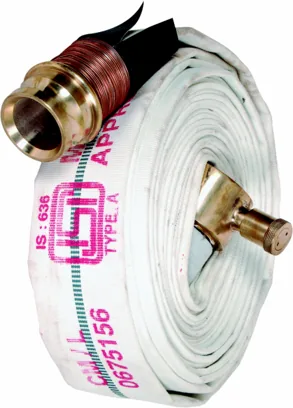
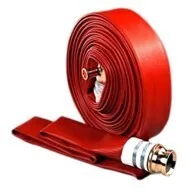
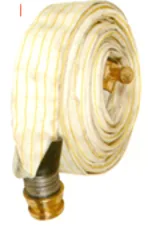
A fire hose carries water from the hydrant or landing valve to the branch pipe. Aaag makes two kinds. RRL means reinforced rubber lined: a rubber lining inside a fabric reinforced jacket woven from 100% synthetic yarn. CP means controlled percolating: water seeps out evenly all round the jacket, so the outside of the hose stays wet, which is why CP hose is used where the hose has to pass through high radiant heat.
Aaag offers RRL hose in two types under IS 636, both ISI marked. Type A (AAAG 351) is the standard RRL hose, with heat and abrasion resistance. Type B (AAAG 352) is built from a seamless, circular woven synthetic fibre reinforcement fully encased in a synthetic polymer; Aaag states it resists grease, oils, acids, alkalies, ozone, fungus, heat and chemicals, is light and flexible, and has very low friction loss. Choose the type named in your approved drawings or tender.
The CP hose (AAAG 353) is made to IS 8423 and ISI marked. That standard includes a flame resistance test in which a lighted blowlamp is held on a length of hose under water pressure, and the hose must not fail. Aaag recommends it for coal mines, textile mills, refineries and high rise buildings.
All three hoses carry the same ratings: 14 bar (200 psi) working pressure, 21 bar (300 psi) test pressure and 35 bar (500 psi) burst pressure. Sizes are 38, 50, 63, 70, 75 and 100 mm, each in 7.5 m or 15 m lengths. Match the hose size to the couplings on your landing valves and branch pipes.