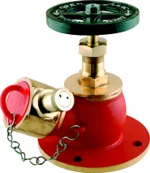
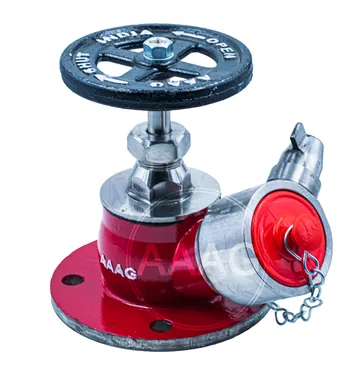
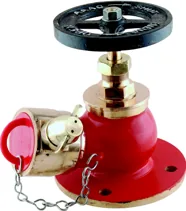
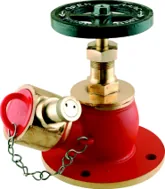
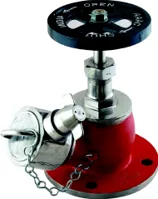
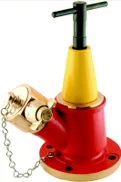
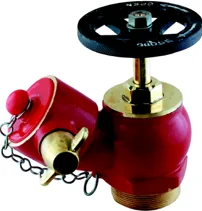
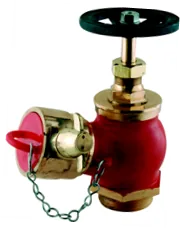
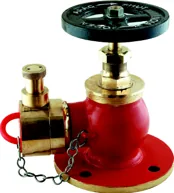
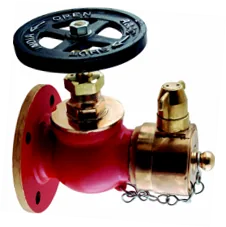
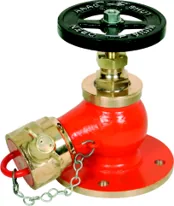
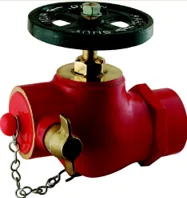
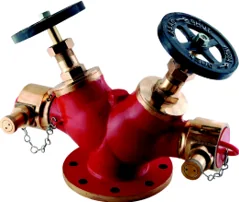
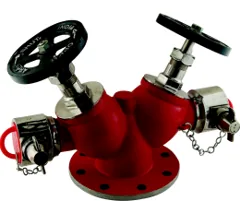
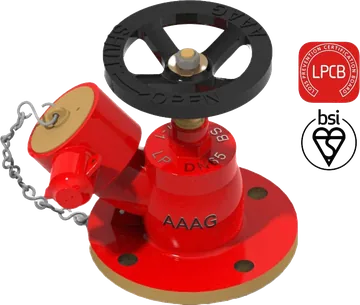
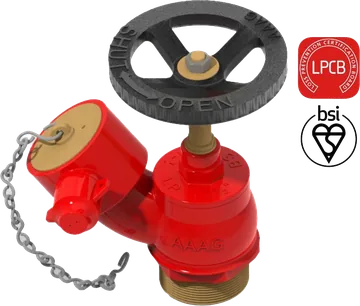
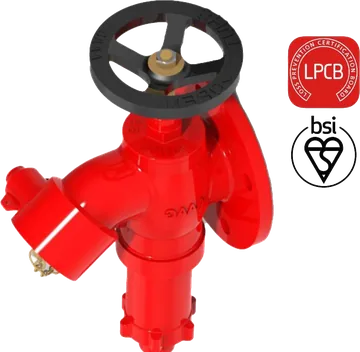
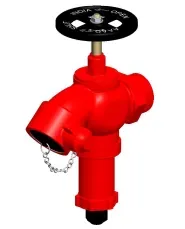
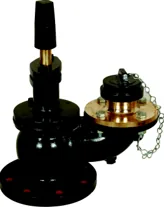
A landing valve, also called a hydrant valve, is the outlet on a wet riser or hydrant main where the fire hose is coupled. Aaag's standard landing valves share one build: a gunmetal body to IS 318 LTB-2, with stainless steel to IS 3444 Gr. I or Gr. IV as an option, a cast iron hand wheel, a 63 mm waterway (50 mm or 38 mm on request), a 63 mm female instantaneous outlet, a 23 bar test pressure and a red polyurethane finish. The gunmetal oblique AAAG 104 is made to IS 5290 Type A, the Indian standard for landing valves, and is ISI approved.
Pick the body pattern that suits your pipework: oblique (AAAG 104, 104S and the BS 5041-1 model 1040), right angle (103), horizontal (105), downward (107) or double outlet (101 in gunmetal, 101S in stainless steel, with a 100 NB inlet flange). Flanged valves have a 75 NB (3 inch) inlet flange drilled to ANSI B 16.5 150#. For threaded pipework choose the oblique valve with a male (108) or female (109) BSP inlet, or the wheel valve (105B). Where valves must not be opened by unauthorised people, the lock shield valve (110) follows a BPCL design.
For approved projects, Aaag offers FM approved oblique valves to FM Specification 1521 in gunmetal (FM104G) or SS 316 (FM104S4), tested to 50 bar, and bronze wet riser valves to BS 5041-1, including the LPCB approved G-104. Where the inlet pressure can be higher than the normal working pressure, a pressure regulating valve keeps the outlet pressure within a safe limit: the bronze model handles inlet pressures up to 20 bar, and a stainless steel model with an 80 mm flanged inlet is also offered.
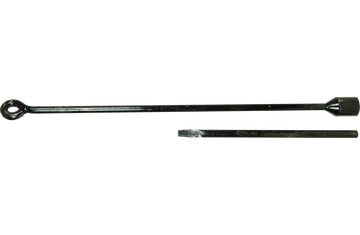
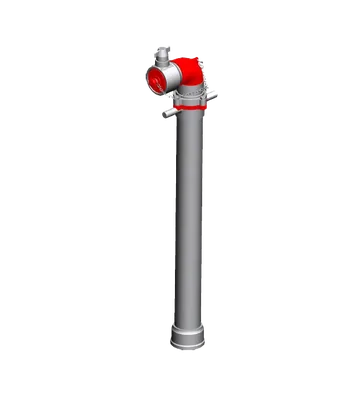
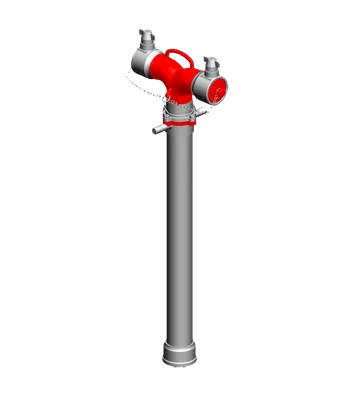
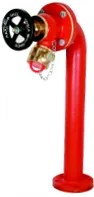
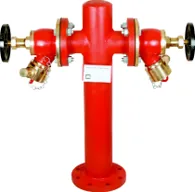
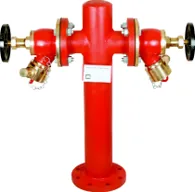
Outside buildings, Aaag wet hydrants in heavy duty mild steel carry one or two hydrant valves, and the M194B adds a 100 NB pumper connection. Underground hydrants (C200) sit below a manhole cover, which suits places such as airports; water is drawn from them with an aluminium standpipe, single or double outlet, and a hydrant key.