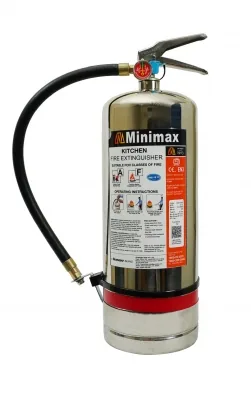
Class F fires involve cooking oils and fats. Minimax states that wet chemical is the only extinguisher type to be used on them, because pressurised jets from other types can throw burning oil onto nearby surfaces and spread the fire. The wet chemical reacts with the hot fat, lowers its temperature and leaves a cooling foam layer on top, and a special nozzle lets the user apply it from a safer distance.
The Minimax kitchen unit is stored pressure, with dry nitrogen at 12 bar in a steel cylinder, in 1, 2, 4, 6 and 9 litre sizes. It works from +5 °C to +60 °C and is also meant to supplement an existing automatic kitchen hood suppression system.
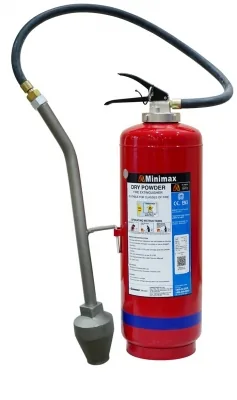
Class D fires involve reactive metals such as lithium, sodium, potassium, magnesium, aluminium powders and paste, titanium, iron and their alloys. The Minimax TEC unit uses a powder made from a eutectic mixture of three salts, applied gently through a low velocity, lance-like cast aluminium nozzle with internal radial fins so the burning metal is not splashed. It is a 10 kg gas cartridge unit with a 180 gms CO2 cartridge, and Minimax states it must only be used on Class D fires. FPS supplies, installs and refills both types in Bhopal and across Madhya Pradesh.