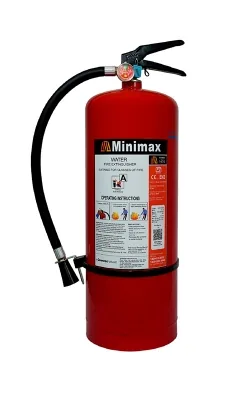
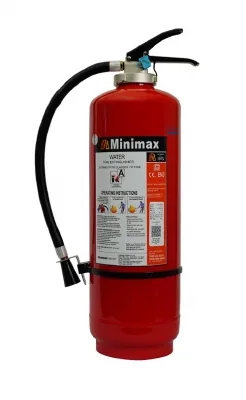
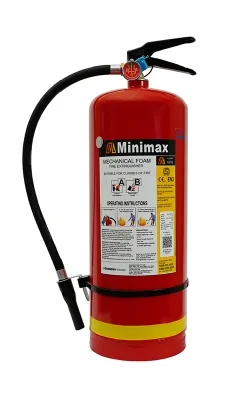
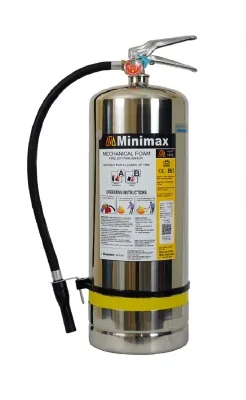
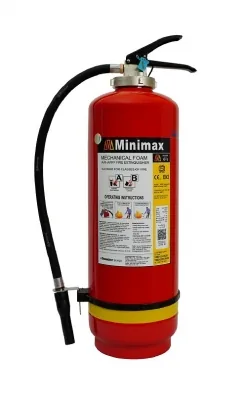
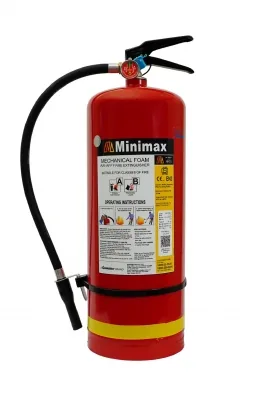
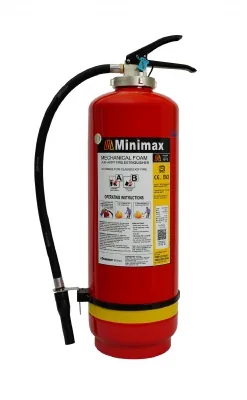
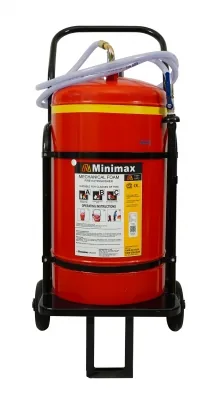
Start with the agent. Water extinguishers work by cooling and suit Class A fires in ordinary solids such as wood, plastics and paper; Minimax states they must never be used on electrically actuated fires. AFFF (aqueous film forming foam) extinguishers cover both Class A solids and Class B flammable liquids such as petrol and spirits, leaving a cooling and blanketing layer that also soaks into absorbent fuel to reduce the risk of the fire starting again.
Choose AR-AFFF where water soluble flammable liquids are stored or used, such as alcohols, ketones, amines, esters, ethers and aldehydes, pure or mixed with hydrocarbons. It forms a thick foam film on the fuel surface that blocks out air. Minimax states that foam types should never be used on electrical fires, flammable gases or cooking fats and oils.
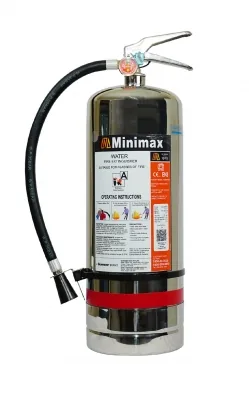
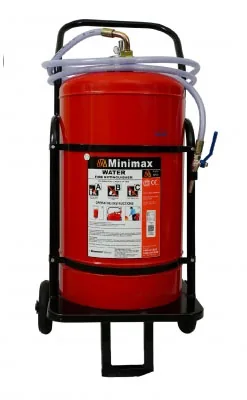
Then choose the operation and body. Stored pressure units use dry nitrogen at 12 bar: water in 2, 6 and 9 L and foam in 9 L, with stainless steel bodies available for coastal and high salinity sites. Gas cartridge units in 9 L use a 60 gms CO2 cartridge and are meant for outdoor and industrial use. Mobile units in 20 and 60 L suit larger risks in severe, usually outdoor, conditions.
Compare the listed ratings: 1A for the 2 L stored pressure water unit, 6A for the 9 L gas cartridge water unit and 20A for the mobile water unit; 4A:233B for 9 L stored pressure foam, 6A:144B for 9 L gas cartridge foam and 20A:233B for mobile foam. Portable units are listed for +5 °C to +60 °C and mobile units for +5 °C to +55 °C. FPS supplies, installs and refills all of them in Bhopal and across Madhya Pradesh.