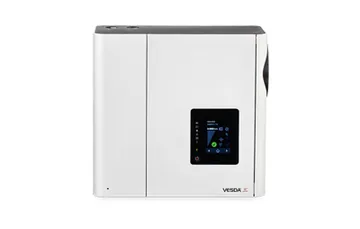
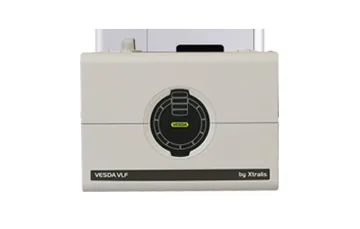
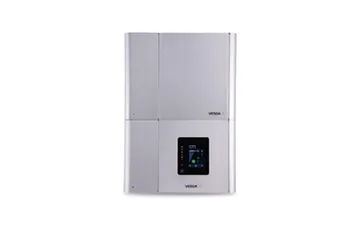
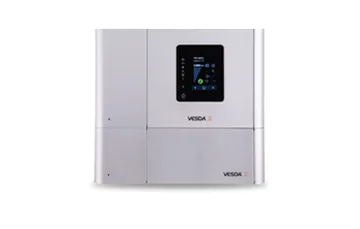
An aspirating smoke detector pulls air from the protected area through sampling holes in a pipe network, filters it, and passes it through a detection chamber where light scattering picks up very small amounts of smoke. This is what gives VESDA detectors their very early warning.
For a small, business-critical area of less than 500 m2 (5,380 sq ft), the VESDA VLF-500 is the compact choice. It has four alarm levels: Alert and Action can be set from 0.025 to 2.00% obs/m, and Fire 1 and Fire 2 from 0.025 to 20.00% obs/m, where % obs/m (obscuration per metre) is a measure of how dense the smoke is. Each alarm can have its own delay of 0 to 60 seconds, and status is shown on the detector display and passed on through relays or optional interface cards.
Where you need to know exactly where the smoke is, the VESDA-E VEA is addressable: it draws air from individual sampling points through multi-channel microbore tubes (6 mm outside diameter) of up to 100 m, divides the space into sampling locations and has three sensitivity settings. It is commissioned with VSC software, has local smoke test ports for servicing, and its filter, smoke sensor module, pump and rotary valve can be replaced on site.
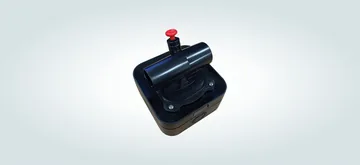
Two StaX add-ons extend VESDA-E systems: the Automated Pipe Cleaning StaX blows dust and lint out of the pipes in dusty sites, and the PSU StaX supplies 24 V power with a charger for standby batteries. For gas threats, the VESDA Sensepoint XCL is a gas detector set up from a phone over Bluetooth. FPS supplies, installs, commissions and maintains all of these in Bhopal and across Madhya Pradesh.