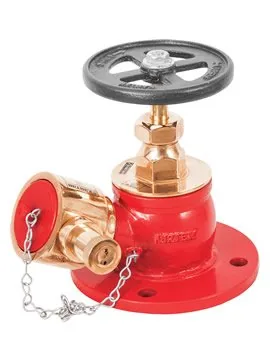
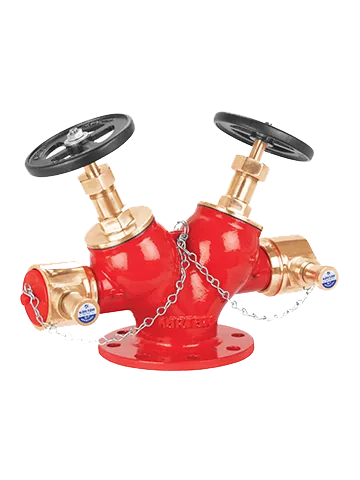
A landing valve is the outlet on a hydrant main or wet riser where the fire hose is connected. Kartar makes its landing valves to IS 5290, the Indian standard for landing valves, with the ISI mark and an ABS blank cap and chain. The single headed valves are Type A: the heavy duty K-901 and the standard K901-E, both in gunmetal or stainless steel with an 80 mm size. The double headed K901-D is Type B, with a 100 mm inlet and two outlets so that two hose lines can run from one point; Kartar lists a test pressure of 21 kg/cm2 for it. Kartar's list describes these as 63 mm valves while its website gives a 65 mm outlet, so we confirm the outlet size against your hose couplings.
Kartar also offers the JMW K901-C, a single headed landing valve with a cast iron body and SS or GM parts, for projects that do not call for an all gunmetal or all stainless steel valve.
For underground hydrant mains, Kartar supplies cast iron fire hydrants to IS 909 Fig. 1A as a complete 80 mm set (sluice valve, duck foot bend, riser, coupling with cap, chain, nuts, bolts and rubber packing), to IS 909 Fig. 1B, and to BS 750 Type 2. IS 909 is the Indian standard for underground fire hydrants and BS 750 is the British one; follow whichever your approved drawings name. Kartar states that its fire hydrants and stand posts come with a CI coupling.
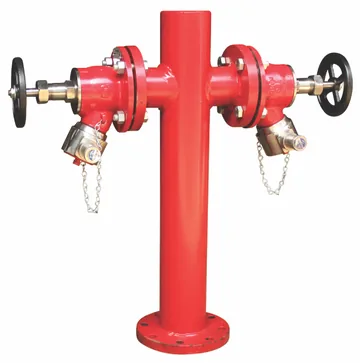
Stand posts raise the outlet above ground. Choose the cast iron single outlet stand post (MCGM type) for one outlet, or the MS fabricated stand post for two landing valves, which has a 100 mm inlet and 80 mm outlets and is supplied without the landing valves, with or without the nuts, bolts and gaskets for its three flanges. Keep spares such as bonnets, spindles, seals and hand wheels on hand for maintenance.