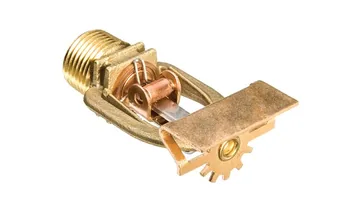
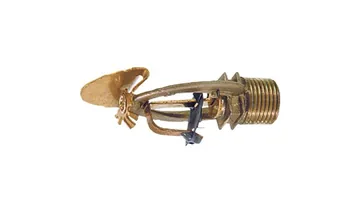
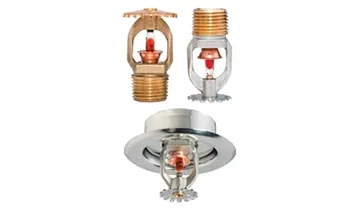
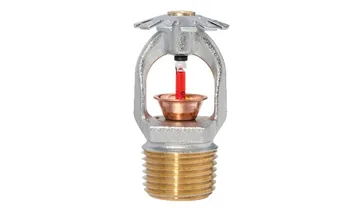
A standard spray sprinkler covers a standard floor area per head and throws water in a spray pattern below the deflector. The K-factor (discharge coefficient) tells you how much water a sprinkler lets through at a given pressure: the higher the K-factor, the more water. Tyco gives these in gpm/psi½ (4.2, 5.6 and 8.0 here) and, for the European style lines, in Lpm/bar½ (57, 58, 80 and 115). The system designer picks the K-factor from the hazard and the water pressure available.
Next, choose the response. Quick response sprinklers (TY-FRB and TY3201 with a 3 mm glass bulb, TY-FRL with a solder link) open sooner in a fire and are described for light and ordinary hazard buildings such as offices, hotels, schools and hospitals. Standard response sprinklers use a 5 mm glass bulb (TY-B) or a solder link (TY-L), and the TY-B and TY-L upright and pendent heads are described for light, ordinary and extra hazard occupancies, which include factories, refineries and chemical plants. The TFP672 TY-B line is special response with a 4 mm bulb, for systems built to VdS rules.
Then pick the mounting style and temperature rating. Upright heads sit on top of the pipe, pendent heads hang below it, recessed pendent heads sit partly inside a two-piece escutcheon in a finished ceiling, and sidewall heads mount on a wall just below a smooth ceiling. Each data sheet prints its own temperature ratings, from 57°C up to 182°C on the TY-B sheets and 74°C, 100°C and 138°C on the TY-L sheets; the right rating depends on the ceiling temperature and the design standard.
Approvals differ by data sheet, so match them to what your consultant or insurer asks for. Tyco lists UL and C-UL listing and FM approval on most of these lines, LPCB and VdS approval on some, and only LPCB and VdS on the metric TFP670 and TFP672 lines. FPS supplies, installs and maintains Tyco sprinklers in Bhopal and across MP and can help you match a data sheet to your design.